LITERARY FICTION / Cormac McCarthy
A father, a son, and every lamp left on.
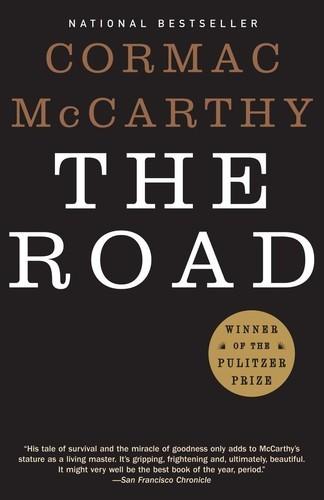
A father and his young son walk south through a burned, ash-covered America, carrying what little they have. McCarthy's spare, incantatory prose makes their journey unbearably tense and unexpectedly tender.
Lights out
The night it started
I opened The Road at about ten, after a long day, because it was short and I thought it would be the kind of book I could read in a couple of sittings. I left the hall light on when I went to bed, which I never do, and I didn't think about why until later.
By midnight I had got up and switched on the lamp in the next room too.
What the book does
A man and his young son are walking south through what is left of the United States, some years after an unnamed catastrophe. The sky is grey, ash falls constantly, the cold is getting worse, nothing grows, and almost no one is left. They push a shopping cart with everything they own, a tarp, blankets, a few cans of food when they can find them. The man has a pistol with very few bullets. They are heading for the coast, in the hope that it will be warmer, or better, or anything at all.
Neither of them has a name. There are no chapters, only short passages separated by white space, and dialogue runs without quotation marks, in brief, plain exchanges between a father and a child. Flashbacks to the boy's mother appear without warning, in dreams and memories, and then vanish again.
Why the lamp stayed on
The first reason is fear, plain and physical. The people who still survive in this world are, many of them, very dangerous, and Cormac McCarthy wastes no words in establishing that. Every abandoned house the pair walk into, every figure on the road behind them, every sound in the woods, made me tense up. There are a few scenes I won't describe that I read with the book held further from my face, as though distance would help.
The second reason is hunger. So much of the book is about food: the hunt for it, the rationing, the hollow-eyed gratitude of finding a tin of something in a wrecked kitchen. When they find anything, I felt relief in my own stomach. I went downstairs at some point after midnight and ate a slice of bread standing up in the kitchen, which tells you something.
But the real pull is the two of them. The father's whole life has shrunk to keeping the boy alive and keeping him good, and those two tasks pull against each other more and more. The boy asks simple questions, again and again, about whether they are still the good guys, and the answers get harder. I kept reading because I could not bear to leave them in the dark on the road. So many passages end with them lying down to sleep in the cold, and I couldn't turn off my own lamp while they were out there.
It's the most frightening book I've read, and somehow the tenderest one too.
The prose
McCarthy's style here is both stripped down and strange: short, plain sentences, then sudden long ones full of old, unusual words, almost like scripture. The rhythm becomes hypnotic. I found myself reading some passages aloud under my breath, which I don't usually do, because they sounded like something meant to be spoken.
A little friction
The bleakness is relentless by design, and the repetition is part of the method: walk, scavenge, hide, sleep, walk again. There were a few stretches in the middle where the pattern felt long even in so short a book. The dialogue between man and boy is deliberately minimal, and occasionally its plainness tipped into something close to monotone for me. And this is not a book for anyone who needs to know what happened to the world. McCarthy never tells you, and that is the right decision, but it can be frustrating.
Who should read it, and when
Read it if you are a parent, or have ever been responsible for a child's safety, but know that it will cost you something. Read it if you want a novel that does a great deal with almost nothing. Don't read it when you are already low. And maybe keep a few lights on.
Last thought before lights-out
I turned off the lamp at 1:17, partway through, because I knew I couldn't finish it that night without lying awake till dawn. I didn't switch off the hall light. I lay there listening to the house, thinking about how small the book's world is, two people and a road, and how enormous the feeling it leaves behind.