NARRATIVE NONFICTION / Jon Krakauer
I climbed Everest's worst night under a duvet.
Krakauer was on assignment on Mount Everest in May 1996 when a storm struck several expeditions near the summit. His account is a gripping, haunted reckoning with ambition, judgment and survival.
Lights out
The night it started
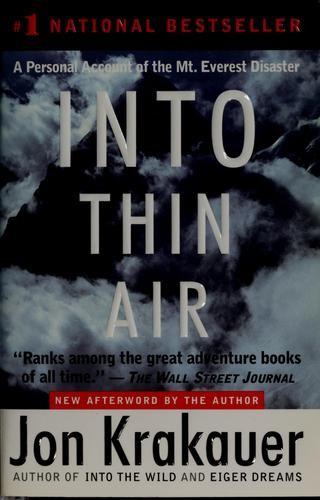
It was a cold night, which felt right. I had the duvet pulled up, the lamp angled low, a mug of tea on the nightstand, and the heating had clicked off for the night. I opened Into Thin Air thinking I would read the first couple of chapters and save the mountain for the weekend. I knew, roughly, how the story goes. Plenty of people do. It did not matter at all.
Jon Krakauer begins near the top, on the summit itself, exhausted and oxygen-starved, looking down at the weather and not yet understanding what it means. Then he steps back and starts again from the beginning, and every page after that is read in the shadow of that opening. I was hooked before the expedition had even reached Base Camp.
What the book does
In 1996 Krakauer, a journalist and experienced climber, went to Everest on assignment for Outside magazine to write about the growing business of guided ascents, in which paying clients are led up the mountain by professional guides. He joined Rob Hall's Adventure Consultants team. Scott Fischer's Mountain Madness expedition was on the mountain at the same time, along with several other teams, all aiming for the summit in the same short window in May.
The first half of the book is about the long, slow approach: the trek in, the weeks of acclimatization, the Khumbu Icefall with its shifting towers of ice and its aluminum ladders laid across crevasses, the rotations up to higher camps and back down again. Krakauer is very good on what altitude does to a body and a mind, how thin air makes every step labored and every decision a little foggier. He is equally good on the people: the clients, the guides, the Sherpa climbers who do so much of the hardest and most dangerous work, the quiet tension between teams sharing one narrow route.
I knew the weather was coming, and I still kept hoping someone would turn around in time.
Why the lamp stayed on
The pull is dread, pure and steady. Every small delay, every slow climber, every fixed rope not yet in place reads differently when you know a storm is coming. Krakauer builds the summit day hour by hour, and somewhere after one in the morning I realized I had been holding my breath through whole paragraphs. I put the book down on the duvet once just to breathe properly and remind myself I was warm and lying down.
What keeps it from being only a disaster story is Krakauer's honesty about himself. He was there, he was impaired by altitude like everyone else, and he does not pretend his memory is perfect or his own choices beyond question. That self-scrutiny is uncomfortable to read. It is also what makes the book feel like testimony rather than adventure.
A little friction
Krakauer is a participant, not a neutral witness, and his judgments of some of the people on the mountain have been disputed. The guide Anatoli Boukreev, for one, published his own account that challenges parts of this one. I found it worth keeping that in mind as I read. The book is strongest when it questions everyone, including its author, and a little less sure-footed when it assigns blame.
Who should read it, and when
Read it in winter, under a heavy blanket, with nowhere you have to be in the morning. You do not need to know anything about climbing; Krakauer explains just enough. If you have ever wanted something badly enough to ignore the warning signs, it will hit closer than you expect.
Last thought before lights-out
I made myself stop at 1:38, not at the end but at a point where I could no longer take in what I was reading. With the lamp off, the room felt very still and very safe, and I lay there aware of every easy breath. I do not think I have ever been so grateful for a warm bed at sea level.