LITERARY SUSPENSE / Fyodor Dostoevsky
A nineteenth-century novel raised my pulse at 3 AM.
A destitute former student in St Petersburg convinces himself he is above ordinary morality and plans a terrible act. Dostoevsky's novel is a psychological thriller of guilt, pursuit and a mind under siege.
Lights out
The night it started
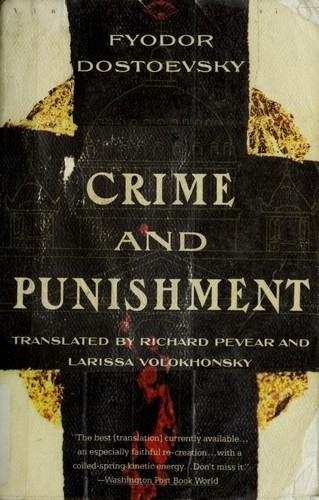
I had been putting off Crime and Punishment for years on the assumption that it was homework: long, heavy, Russian, important. I picked it up on an evening when nothing else on the shelf appealed, in the Pevear and Volokhonsky translation, meaning to read the opening chapters as a kind of duty and then go to sleep with a clear conscience.
At 3 AM I was sitting bolt upright, both feet on the cold floor, with my heart going faster than it had any right to over a novel from 1866.
What the book does
Rodion Raskolnikov is a former law student in St Petersburg, broke, half-starved and living in a cramped little garret under the roof of a tenement. It is high summer, and the city is airless: dust, heat, taverns, drunks, stairwells that smell. He has stopped going out, stopped eating properly, and has been turning over a theory about whether certain extraordinary people are permitted to step over the moral law for a greater purpose. He has also been thinking about the elderly pawnbroker who has been taking his few valuables in exchange for small loans.
None of this is a spoiler. The crime happens early, in Part One, and the book is not interested in whether it will occur. It is interested in everything after: what the act does to the mind that committed it.
Why the lamp stayed on
What surprised me is that this is, structurally, a thriller. Once the act is done, Raskolnikov drifts through the city in a fever, and every encounter becomes a test. A conversation in a police office about something completely unrelated turns into a minefield. A chance remark in a tavern lands like an accusation. He keeps returning, almost against his will, to the scene. I found myself reading faster and faster, the way you do in a modern suspense novel, because I was inside his panic and could not find the way out either.
Then there is Porfiry Petrovich, the investigating magistrate, and their conversations are the best scenes of cat-and-mouse I have read. Porfiry is friendly, rambling, a little ridiculous, and he never quite says what he means. Raskolnikov can't tell whether he is suspected, toyed with, or imagining all of it. Neither could I. I read one of their meetings at about half past two and had to get up and walk to the window afterwards.
I kept checking the dark hallway, as if someone might be standing at the top of the stairs.
The book isn't all fever. Around Raskolnikov, Dostoevsky builds a crowded, noisy world: his loyal, talkative friend Razumikhin; his mother and his sister, Dunya, who arrive in the city with complicated plans of their own; the drunken former clerk Marmeladov, whose long confession in a tavern is one of the saddest scenes in the book; and Marmeladov's daughter Sonya, whose quiet faith becomes a kind of counterweight to Raskolnikov's theories. These people kept the book from being only a nightmare. They gave it a heart.
A little friction
It is long, and it is talky. Characters deliver speeches that go on for pages, and some of the subplots, particularly around Dunya's suitors, slowed me down in the middle. The translation keeps some of Dostoevsky's roughness and repetition rather than smoothing it out, which I came to like but which takes a few chapters to settle into. There were moments where I wanted the book to get back to Porfiry and stop explaining itself.
Who should read it, and when
If you love psychological suspense and have never tried the classics because they seem like an assignment, this is the one to start with. Read it in long sittings, not ten pages at a time; the fever only works if you let it build. A hot summer night, windows open, the city noises coming in, would be ideal. I had a cold autumn one and it still worked.
Last thought before lights-out
I switched the lamp off at 3:21, not because I'd reached a good stopping place but because my eyes were burning. Lying in the dark, I noticed that I was replaying one of Porfiry's conversations, trying to work out what he had really known. A detective story without a mystery about who did it, and it still kept me guessing until the small hours.