GOTHIC FICTION / Shirley Jackson
A short book that left the hallway light on.
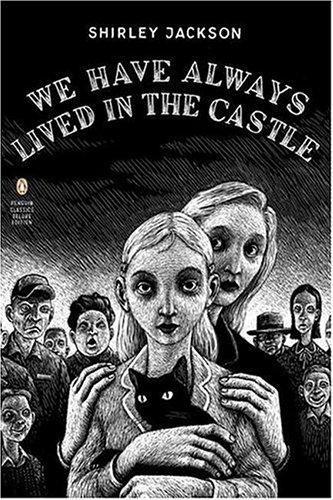
Mary Katherine Blackwood lives in a shuttered house with her sister and their uncle, shunned by the village below. Jackson's last completed novel is a fairy tale gone sour, funny and chilling in the same breath.
Lights out
The night it started
It's a short book, and I picked it precisely because it was short. I thought I'd read half of it before bed and save the rest. That was around eleven. By a little before one I had finished it, and then I got up and switched on the hallway light, which is not something I usually do.
Nothing in We Have Always Lived in the Castle jumps out at you. That is not how Shirley Jackson works. The fear in this book is quieter and much harder to switch off.
The hook
Mary Katherine Blackwood, called Merricat, is eighteen. She lives with her older sister, Constance, and their elderly Uncle Julian in the big Blackwood house outside a village that hates them. Six years earlier, most of the family died at the dinner table after arsenic found its way into the sugar bowl. Constance was tried and acquitted. Since then she has not gone farther than the garden. Uncle Julian, who survived but was left frail and confused, spends his days writing and rewriting his account of that last evening.
Twice a week, Merricat walks down into the village for groceries and library books, and the villagers stare and the children chant a rhyme behind her. Then a cousin, Charles, arrives at the door, and the careful balance of the house begins to tilt.
What kept the lamp on
The first pull is Merricat's voice, and it is one of the strangest and best narrating voices I know. She introduces herself with a short list of her likes and dislikes, and the list is both charming and slightly alarming, the way a child's list might be if the child were a little too interested in poisonous mushrooms. She has rituals. She buries objects around the property and nails things to trees to protect the house. She has magic words. She dreams about living on the moon. Her logic is entirely her own and entirely consistent, and after about twenty pages you stop questioning it and start following it, which is exactly the trap.
The second pull is Constance. She is gentle, beautiful, endlessly patient, always cooking, and the cellar of the house is lined with jars of preserves put up by generations of Blackwood women. The scenes of the sisters in their kitchen are some of the coziest pages Jackson ever wrote, and they are also unsettling, because you can never quite tell what the coziness is protecting.
It's a book about a safe room, and the more I read, the less sure I was of who it was safe from.
The third pull is the village. Jackson was brilliant at the cruelty of ordinary people, and the scenes of Merricat walking through town, the general store, the café, the stares, are painfully exact. You feel the eyes on her. You also begin to understand that the villagers' hostility and the household's withdrawal are feeding each other, and that something, sooner or later, is going to break.
A little friction
Because the book is so compressed and so committed to Merricat's point of view, some of the other characters are thinner than I wanted. Cousin Charles in particular is drawn in broad strokes, more a force than a person. I suspect that's deliberate, since we only see him through Merricat's eyes, but it did make the middle section feel a little schematic. It is a minor complaint about a book that does so much in so few pages.
Who should read it, and when
Read it in one sitting if you can, on a night when the house is quiet. It's short enough to finish before midnight if you start early, though I didn't manage it. Anyone who loves fairy tales with something rotten at the root, or who has read The Haunting of Hill House and wants more of Jackson's particular chill, should start here.
Last thought before lights-out
At 12:58 I turned off the bedside lamp. The hallway light stayed on until morning. I'm not entirely sure what I thought would come up the stairs, only that Merricat would have known what to bury, and where.